Höfundur vefsetursins hefur frá árinu 2016 sent mæligögn yfir myrkvatvístirni og fjarreikistjörnur í gagnagrunninn VarAstro (áður O–C Gateway hjá Brno Regional Network of Observers [B.R.N.O.] og TRansiting ExoplanetS and Candidates [TRESCA]), sem Stjörnufræðifélag Tékklands rekur.
Since 2016, the author of this website has submitted observational data of eclipsing binaries and transiting exoplanets to the database VarAstro (formerly O–C Gateway of the Brno Regional Network of Observers [B.R.N.O.] and TRansiting ExoplanetS and Candidates [TRESCA]), operated by the Czech Astronomical Society.
VarAstro-gagnagrunnurinn birtist fyrst á netinu árið 2006, þá nefndur tékkneska breytistjörnuskráin (CzeV). Hann var settur upp af tékkneska stjörnufræðingnum Luboš Brát sem opin gagnagrunnur yfir nýlega fundnar breytistjörnur, sem tékkneskir stjörnuathugendur höfðu uppgötvað en voru ekki skráðar í Altæku breytistjörnuskrána (General Catalogue of Variable Stars [GCVS]) eða Breytistjörnuskrá AAVSO (Variable Star IndeX [VSX]).
The VarAstro database appeared online in 2006, initially as the “Czech Variable Star Catalogue” (CzeV). It was established by the Czech astronomer Luboš Brát and intended as an open database of recently discovered variable stars by Czech observers, stars that were not listed in the General Catalogue of Variable Stars (GCVS) or the Variable Star Index (VSX) maintained by the American Association of Variable Star Observers (AAVSO).
Uppphafsmaðurinn að þessu er stjarneðlisfræðingurinn Miloslav Zejda en hann hafði safnað athugunum tékkneskra stjarnmælingamanna, uns CzeV-skráin var komið upp. Það er “Breytistjörnu- og fjarreikistjörnudeild” tékkneska stjörnufræðifélagsins sem annast CzeV-skrána. Nánari frásögn um tilkomu gagnagrunnsins er hér.
The original idea was conceived by the Czech astrophysicist Miloslav Zejda, who had been collecting observations from Czech astronomers until the CzeV catalogue was established. The catalogue is managed by the Variable Star and Exoplanet Section of the Czech Astronomical Society. For further details of the initials of the database, see here.
Á sama tíma hóf evrópskt rafrænt tímarit um breytistjörnur, “Open European Journal on Variable Stars” (OEJV), útgáfu á netinu. Tímaritið er opið öllum sem vilja birta rannsóknir sínar á breytistjörnum, og greinarnar ritrýndar eins og venjan er hjá öðrum vísindatímaritum.
Concurrently, the online journal Open European Journal on Variable Stars (OEJV) was established as an open-access, peer-reviewed platform for publishing research on variable stars.
Niðurstöður höfundar ásamt öðrum athugendum hafa birst í Open European Journal on Variable Stars (Times of minima, B.R.N.O. Contributions # 40. OEJV, febrúar 2017 og B.R.N.O. Contributions #41 – Times of minima, OEJV, janúar 2021).
The author’s results, along with other observers, have been published in contributions of the B.R.N.O. series on times of minima (e.g., Times of minima. B.R.N.O. Contributions # 40, February 2017; B.R.N.O. Contributions #41, January 2021).
Ljósmælingar - Photometry
Þegar niðurstöður mælinga á myrkvatvístirnum eða þvergöngum fjarreikistjarna verða opinber í gagnagrunni VarAstro getur stjörnufræðisamfélagið eða aðrir nýtt þær í rannsóknir.
When photometric results of eclipsing stars or exoplanet transits become accessible in the VarAstro database, the astronomical community or others can use them for scientific study.
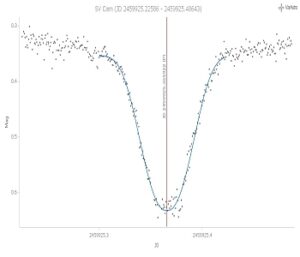
- Myrkvastjörnuathuganir höfundar á VarAstro-gagnagrunninum. Smelltu á myndina.
- Eclipsing binary observations by the author in the VarAstro database. Click on the thumbnail.
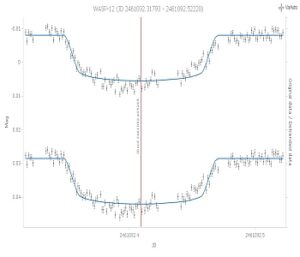
- Fjarreikistjörnuathuganir höfundar á VarAstro-gagnagrunninum. Smelltu á myndina (í vinnslu).
- Exoplanet transit observations by the author in the VarAstro database. Click on the thumbnail (in progress).